
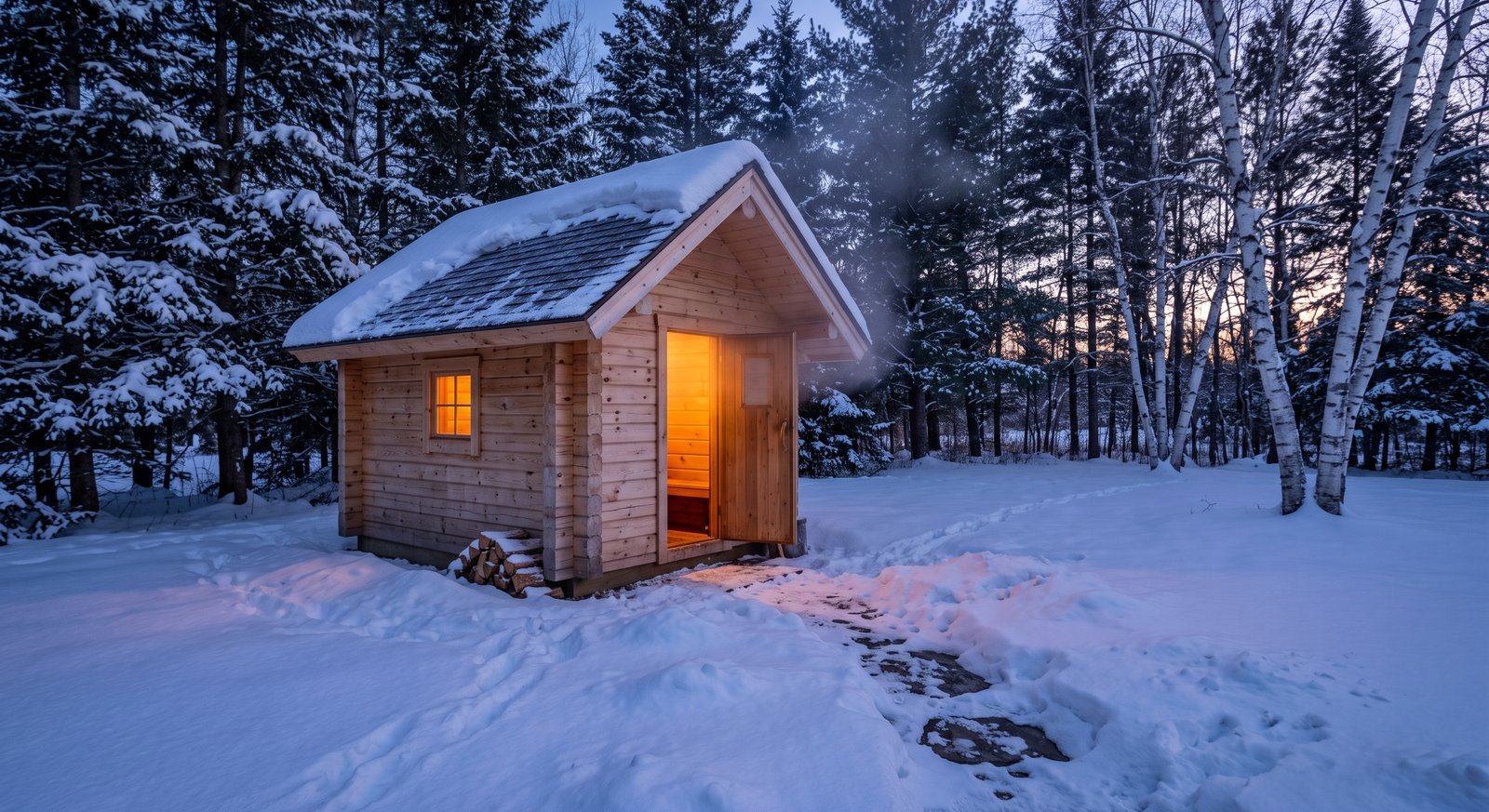
Few things suit a Canadian winter better than an outdoor sauna: twenty minutes of dry heat, a roll in the snow or a jump in the lake, and back in again. Outdoor sauna kits have made it realistic for homeowners to build one in a weekend or two, but the options can be confusing. Barrel or cabin? Electric or wood-fired? Cedar or spruce? This buyer’s guide answers those questions and explains what to look for in the best outdoor sauna for your yard.
Types of sauna kits
Cabin sauna
A small rectangular building with straight walls and a pitched roof. It uses floor space efficiently, is easy to insulate, and can include a changing room or covered porch. Read more in our guide to the cabin sauna.
Barrel sauna
A cylinder of curved staves held by steel bands. Barrel saunas look striking and heat a small volume quickly, but the curved walls reduce usable bench and head space, and the shape makes adding insulation or a changing room harder.
Pod and cube saunas
Modern shapes with large glass panels. Beautiful, but glass loses heat fast, which matters at minus 20.
Indoor (home) sauna kits
Panel kits designed to go in a basement or bathroom. They need a dry, ventilated room and usually an electric heater or infrared panels. If you have space in the yard, an outdoor sauna avoids moisture inside the house.
Traditional vs infrared
A traditional sauna heats the air to roughly 70 to 100 °C with a heater and stones, and you can throw water on the stones for steam (löyly). An infrared sauna warms your body directly at lower air temperatures. Most outdoor sauna kits in Canada, including ours, are designed for traditional heaters.
What size outdoor sauna do you need?
| Bathers | Typical interior of the hot room | Notes |
|---|---|---|
| 1 to 2 (2 person outdoor sauna) | About 4×5 to 5×6 ft | Fast to heat, small heater |
| 3 to 4 | About 6×6 to 6×7 ft | The most popular family size |
| 5 to 6 | About 7×7 to 7×8 ft | Two bench levels along two walls |
| 6+ with changing room | Hot room plus a separate dressing area | Best for cottages and year-round use |
Allow about 2 ft of bench length per seated person. Keep the ceiling at about 7 ft: higher ceilings waste heat above the top bench.
Our sauna cabin kits cover the range from a small outdoor sauna to a full sauna house:
- Twinbirch 1.7 in (44 mm) sauna cabin kit: 65 sq ft (6.0 m²).
- Whispering Pine 1.7 in (44 mm) sauna cabin kit: 97 sq ft (9.0 m²).
- Winterberry 1.7 in (44 mm) sauna cabin kit: 183 sq ft (17.0 m²).
Electric or wood-burning heater?
| Electric heater | Wood-burning stove | |
|---|---|---|
| Best for | Suburban and city lots, frequent short sessions | Cottages, off-grid sites, the traditional experience |
| Needs | A dedicated 240 V circuit, installed under an ESA permit | Chimney, clearances, WETT-certified installation, usually a building permit |
| Heat-up time | Typically 30 to 60 minutes; can be put on a timer or app | Typically 45 to 90 minutes |
| Running cost | Electricity | Firewood |
| Atmosphere | Clean and simple | Crackling fire, soft heat |
Heaters are sized by the volume of the hot room. A common rule of thumb is about 1 kW per cubic metre for a well-insulated room, with extra for glass doors, windows and uninsulated log walls. Always follow the heater maker’s sizing chart.
Cedar, spruce or thermowood?
- Cedar sauna kits are prized for their aroma and natural decay resistance. Cedar is soft and costs more, and some people are sensitive to cedar dust and oils.
- Nordic spruce is the traditional Finnish and Scandinavian sauna wood: slow-grown, dense, stable and more affordable. Our sauna cabin kits use solid 1.7 in (44 mm) Nordic spruce wall logs.
- Thermally modified wood is heat-treated for stability and rot resistance, mostly used for benches and cladding.
- Benches are usually made from aspen, alder or abachi because they stay cooler to the touch and have no resin pockets.
Using an outdoor sauna in a Canadian winter
- Insulate if you sauna often in deep cold. Solid log walls hold heat well, but adding insulation to the roof and walls of the hot room shortens warm-up time in January.
- Keep the path clear. Plan a short, lit, non-slip route from the house.
- Ventilate. A fresh-air intake low near the heater and an exhaust high on the opposite side keep the air fresh and the wood dry.
- Foundation. Build on a level, frost-protected base: concrete piers, helical piles or a compacted gravel pad with beams.
Do you need a permit for an outdoor sauna in Canada?
- The electrical connection for an electric heater needs an electrical permit (ESA in Ontario) in every case.
- A wood-burning stove usually needs a building permit, and your insurer will want a WETT inspection.
- In Ontario, small buildings under 10 m² (108 sq ft) without plumbing are generally exempt from a building permit. Some municipalities exclude heated buildings from the larger 15 m² exemption.
- Zoning setbacks apply to all buildings, and a sauna with a shower or sink needs a permit because of the plumbing.
Our guide to building permits for small buildings in Ontario explains the size limits.
What is in an outdoor sauna kit (and what isn’t)?
Always read the listing carefully. Our sauna cabin kits include precision-cut Nordic spruce wall logs, door and window joinery, profiled floor and roof boards, impregnated foundation beams, shingles, fasteners and step-by-step instructions.
Not included: the heater, foundation or slab, interior finishing (benches, backrests, lighting), insulation, electrical work, and exterior stain. Budget for these from the start so you are not surprised.
What does an outdoor sauna cost?
Think of the total project in five parts:
- The sauna kit.
- The heater and stones.
- Foundation and site work.
- Interior: benches, backrests, lighting, thermometer, bucket and ladle.
- Installation: an electrician for an electric heater, a WETT-certified installer for a wood stove.
Kit prices are listed on each product page, and you will often see seasonal sale pricing. For a step-by-step look at building one, read our DIY sauna kit guide.
How to choose the best outdoor sauna for you
- How many people will use it at once, and how often?
- Do you have 240 V power near the site, or is a wood stove more practical?
- Do you want a changing room or porch?
- Will you use it in January? If so, plan insulation and a quick, safe path.
- How long can you wait? Our sauna kits are made to order, so allow roughly 4 to 18 weeks from order to delivery depending on season and shipping schedule.
Browse all outdoor sauna kits or contact us for help choosing a size.
FAQ
How long does it take to build an outdoor sauna kit?
Two people can typically raise the shell of a small sauna cabin kit over a weekend. Allow more time for the foundation, roofing, interior benches and heater installation.
Is a cedar sauna better than a spruce sauna?
Not necessarily. Cedar has a lovely aroma and natural rot resistance; slow-grown spruce is the traditional Nordic choice, stronger and more affordable. Both make excellent saunas.
Can you use an outdoor sauna in winter in Canada?
Yes, that is when most people enjoy it most. Plan for warm-up time, ventilation, a frost-protected foundation and a clear path.
What size heater does a 2 person outdoor sauna need?
Small hot rooms usually need a heater in the 3 to 6 kW range, depending on volume, glass and insulation. Check the heater maker’s sizing chart.

