
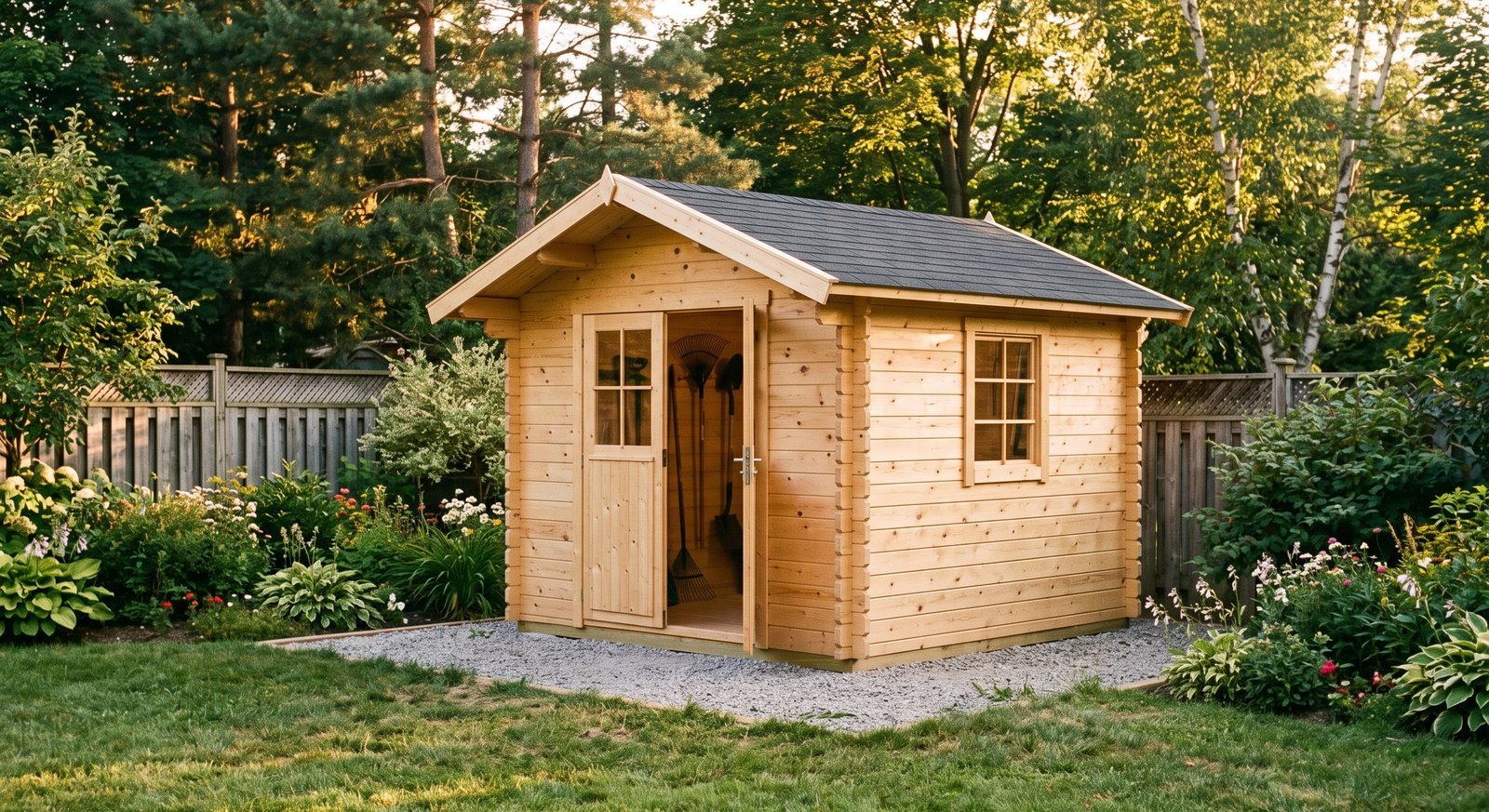
Wooden garden sheds are still the first choice for Canadian homeowners who want storage that looks good and lasts. Wood handles heavy snow loads, does not dent like steel or go brittle in the cold like plastic, and can be repaired, re-stained and modified for decades. But not every wooden shed is built the same. This guide explains what separates a wooden shed that lasts 30 years from one that sags after five, and how to pick the right size for your yard.
Wood vs metal vs resin sheds
| Wooden shed | Metal shed | Resin/plastic shed | |
|---|---|---|---|
| Snow load | Strong roof structure, easy to reinforce | Thin panels can buckle | Roofs can sag under wet snow |
| Cold-weather performance | Unaffected by cold | Condensation inside | Becomes brittle below freezing |
| Shelving and hooks | Screw anywhere | Needs special brackets | Limited load points |
| Lifespan with basic care | Decades | 10 to 20 years, rust at seams | 10 to 15 years |
| Looks | Natural, can be painted to match the house | Utility | Plastic |
| Maintenance | Stain or paint every few years | Rust treatment | Low |
Wood costs more up front than the cheapest big-box sheds, but it is the only option you can realistically keep for the life of the house.
Two ways to build a wooden shed
Framed wooden sheds
Most wooden sheds sold at home centres are stick-framed: 2×4 studs covered with plywood or OSB and siding. They are economical, but the panels are the weak point. Once water gets behind the siding, OSB swells and rots.
Solid-wood (log) wooden sheds
A solid-wood shed is built from interlocking wall planks, usually with tongue-and-groove profiles, that stack on top of each other and lock at the corners. The wall is the structure, the exterior and the interior. There is no sheathing to rot and nothing hidden behind the siding. Our garden sheds use this method with kiln-dried Nordic spruce in 1.1 in (28 mm) and thicker profiles.
Spruce, cedar or pressure-treated?
- Nordic spruce grows slowly in a cold climate, so it has tight growth rings and good strength for its weight. It needs a quality stain or paint after assembly.
- Western red cedar is naturally rot-resistant and smells wonderful, but it is softer, more expensive and dents easily.
- Pressure-treated lumber is ideal for the floor frame and anything touching the ground, but it is rarely used for the walls of a good-looking shed.
For most people, a spruce shed on a treated or well-drained base, finished with a good exterior stain, is the best balance of cost, strength and lifespan.
What size wooden shed do you need?
| Use | Typical size | Door width to look for |
|---|---|---|
| Hand tools, hoses, pots | 4×6 to 6×6 ft | 30 in or more |
| Push mower, bikes, garden tools | 6×8 to 8×8 ft | 32 to 36 in |
| Riding mower or snowblower | 8×10 to 10×12 ft | Double door, 48 to 60 in |
| Workshop or potting shed | 10×12 ft and up | Double door plus a window |
Measure your largest item, add 2 ft of walking space around it, and remember that the shelves will fill up faster than you expect.
Small wooden garden sheds
If you only need tool storage, a small wooden garden shed under 50 sq ft fits beside a fence or at the end of a garden bed. Examples from our range:
- Acorn 1.1 in (28 mm) garden tool shed kit: 5’11” x 5’11” outside, 34 sq ft (3.2 m²) inside, with a full-height 33 in door and a 6 ft wall height.
- Bluebell 1.1 in (28 mm) garden shed kit: 46 sq ft (4.3 m²) inside.
- Maple Hollow 1.1 in (28 mm) garden tool shed: 43 sq ft (4 m²), delivered fully assembled.
Wooden utility sheds
For mowers, snowblowers and a workbench, you are looking at a wooden utility shed of 80 to 160 sq ft. Above about 160 sq ft, consider a small garage instead: our log garage kits start at 178 sq ft (16.5 m²) and take a wide door.
Do you need a permit for a wooden shed in Canada?
In Ontario, a detached storage shed up to 15 m² (161 sq ft) gross area, one storey, with no plumbing, does not need a building permit. Most other provinces and municipalities set a limit of about 10 m² (108 sq ft). In both cases, zoning setbacks and height limits still apply. Read more in our guide to permit-free shed sizes in Ontario.
Foundation: the part that decides how long a shed lasts
A wooden shed lasts as long as it stays dry underneath. The good options:
- Compacted gravel pad with treated skids or beams: drains well and suits most sheds.
- Deck blocks or helical piles: good on slopes and in clay.
- Concrete slab: best for heavy equipment and workshops.
Whatever you choose, keep the bottom wall logs at least 4 in above the ground. Our guide to the best foundation for a bunkie applies equally to sheds.
Wooden shed kits vs a built-on-site shed
A wooden shed kit arrives with every piece cut and numbered. Two people with basic tools can usually raise the walls of a small shed in a day and finish the roof boards the next. You add the roofing material (shingles, metal or membrane) and a finish. Compare the options in prefab shed kits vs DIY kits.
Caring for a wooden shed
- Stain or paint all exterior surfaces within a few weeks of assembly, including the end grain at the corners.
- Install gutters or at least a drip edge so water does not splash back onto the bottom logs.
- Keep soil, mulch and snowbanks away from the walls.
- Check the finish every spring and recoat the sunny and weather sides every three to five years.
- Keep the door and window fittings adjusted as the wood settles.
Wooden sheds for sale in Canada: what to check before you buy
- Wall thickness and species, not just the photo.
- Interior vs exterior dimensions: important for permits and placement.
- What is included: floor, roof boards, door hardware, window glazing, roofing.
- Lead time and delivery: in-stock kits can arrive within weeks; made-to-order kits take longer. See our delivery information.
- Warranty: read the terms. Ours are on the warranty page.
Browse our garden shed kits and wooden sheds, or read about storage shed kits and she shed kits.
FAQ
How long does a wooden shed last in Canada?
A well-built wooden shed on a dry foundation, kept stained or painted, can last 30 years or more. Most early failures come from ground contact and water splash, not the cold.
Is a wooden shed better than a metal shed?
For Canadian winters, usually yes: wood copes better with snow loads, does not sweat with condensation, and is easier to fit out with shelves.
What is the best wood for a garden shed?
Slow-grown spruce gives good strength at a sensible price; cedar adds natural rot resistance at a higher cost. Either needs a dry foundation.
Can I insulate a wooden shed?
Yes. Solid-wood walls can be insulated inside or out if you want to turn the shed into a workshop or studio. See our guide on how to insulate a bunkie.

