
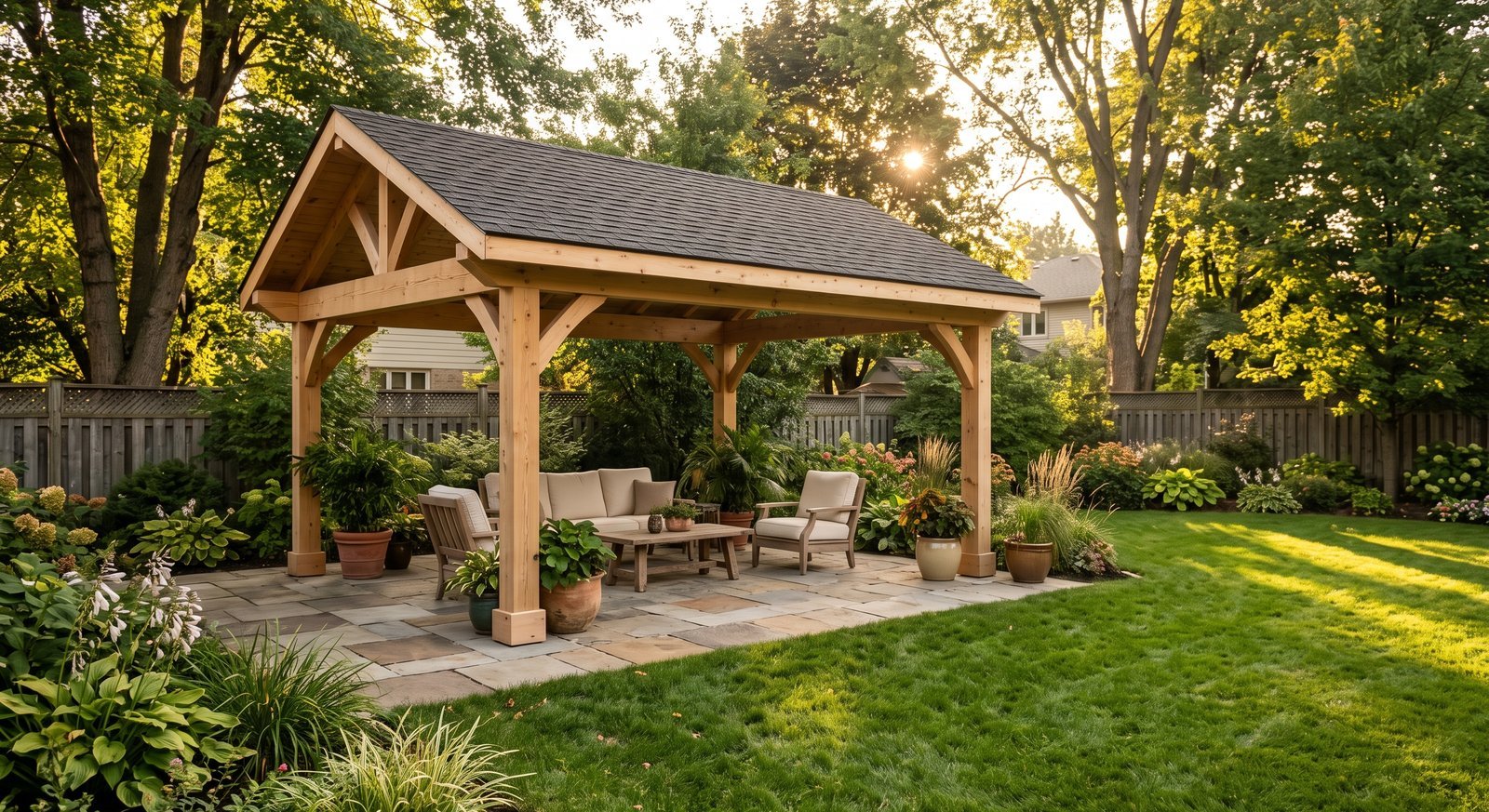
A pergola is the quickest way to make a patio feel like a room. Search for pergola kits in Canada, though, and you will find everything from slim aluminium frames with louvred roofs to heavy cedar beams and covered wooden pavilions. They solve different problems. This guide breaks down the main types of pergola kit, what each one does well in a Canadian climate, and how to size and install one yourself.
First decision: open or covered?
Open pergola
The classic pergola has posts, beams and spaced rafters or slats on top. It gives filtered shade, frames a view, and supports climbing plants, string lights or a retractable shade sail. It does not keep rain off, and in winter snow simply falls through.
Covered pergola (pavilion style)
A covered pergola has a solid roof: boards and shingles, metal panels, polycarbonate, or motorized louvres. You can sit under it in the rain and leave cushions out, but it must be designed to carry snow.
| Open pergola | Covered pergola | |
|---|---|---|
| Shade | Partial, moves with the sun | Full |
| Rain protection | None | Yes |
| Snow load | Minimal | Must be designed for it |
| Cost | Lower | Higher |
| Best for | Patios, gardens, climbing plants | Outdoor dining, lounge, hot tub, all-weather use |
Wood, cedar or aluminium pergola kits?
Aluminium pergola kits
Powder-coated aluminium is light, does not rot, and suits modern houses. Many kits have adjustable louvres. On the downside, lighter frames need careful anchoring in wind, louvred roofs have snow-load limits you must respect (some need to be opened or cleared in winter), and you cannot easily repaint or modify them.
Cedar pergola kits
Western red cedar is naturally rot-resistant and looks beautiful. It is also soft and relatively expensive, and it still needs a finish if you want to keep its colour rather than letting it weather to grey.
Spruce and pine pergola kits
Slow-grown spruce is strong, stable and more affordable than cedar. It needs an exterior stain or paint, which also lets you choose any colour. Solid-wood construction with heavy members gives a covered pergola the strength to carry snow.
Sizing a pergola
| Use | Suggested size |
|---|---|
| Bistro table for two | 8×8 ft |
| Conversation set for four | 10×10 ft |
| Dining table for six | 10×12 to 12×12 ft |
| Outdoor kitchen plus dining | 12×16 ft and up |
Allow at least 3 ft between the edge of your furniture and the posts so chairs can slide back. If the pergola is next to the house, keep its roof below the house eaves and leave a gap so snow and water from the house roof do not dump onto it.
A covered wooden pergola kit: the Arbor Grove
Our Arbor Grove wooden pergola kit is a covered, freestanding pergola in solid Nordic spruce:
- 84 sq ft (7.8 m²) floor area, about 9’10” x 9’10” across the wall logs.
- 1.6 in (40 mm) wall logs and 0.7 in (18 mm) floor and roof boards.
- Gable roof at 22 degrees with an 8’9″ side-wall height and a 10’10” ridge.
- Seven packages, about 661 lb (300 kg) in total.
- Includes precut wall logs, profiled floor and roof boards, fasteners and instructions. Roof covering, foundation and stain are not included.
If you want something larger or more enclosed, compare our wooden gazebo kits.
Do you need a permit for a pergola in Canada?
It depends on your municipality, the size, and whether the pergola is attached to the house. As a rule of thumb:
- Freestanding open pergolas are often exempt, but zoning setbacks and height limits still apply.
- Covered structures are treated like other small buildings. In Ontario, structures under 10 m² (108 sq ft) without plumbing are generally permit-free; larger ones may need a permit.
- Anything attached to the house, or to a deck attached to the house, usually needs a permit.
Check with your municipality. Our article on permit-free building sizes in Ontario explains the 10 m² and 15 m² limits.
DIY pergola kits: how assembly works
- Prepare the base. Concrete piers, helical piles or a compacted gravel pad with beams. For a covered pergola, the base must carry the snow load down to the ground.
- Set out and level. Check the diagonals so the structure is square.
- Raise the frame. On a solid-wood kit, numbered logs stack and interlock at the corners; on a post-and-beam kit, posts are anchored and beams bolted on top.
- Fit the roof. Rafters or slats on an open pergola; roof boards on a covered one.
- Roofing and finish. Shingles, metal or membrane on a covered roof, then stain everything.
Two people with basic tools can assemble most DIY pergola kits in a weekend. The foundation usually takes longer than the pergola itself.
Pergola kits and Canadian winters
- Snow: clear heavy snow from covered and louvred roofs after storms. Follow the manufacturer’s snow-load guidance.
- Frost: piers and piles should go below the frost line or be designed to resist frost heave.
- Wind: anchor every post or wall to the foundation.
- Moisture: keep wood off the ground and finish end grain carefully.
Choosing the right pergola kit: quick checklist
- Do you need rain protection? Choose covered.
- Do you want climbing plants or a light, open look? Choose open.
- Modern house and low maintenance? Aluminium.
- Natural look, can be modified and re-stained? Wood.
- Check what is included: roof covering, anchors, foundation hardware.
- Check lead time and delivery to your area. See our delivery page.
Browse our gazebo and pergola kits, or ask us about sizes and delivery.
FAQ
Are pergola kits worth it?
Yes, for most homeowners. A kit arrives with the joinery done and parts cut to length, which saves a lot of measuring and cutting and reduces mistakes.
What is the best material for a pergola in Canada?
Aluminium for low maintenance, cedar for natural rot resistance, and solid spruce for strength and value. For a covered pergola that stays up in winter, a solid-wood structure designed for snow is a safe choice.
Can a pergola withstand snow?
An open pergola lets most snow fall through. A covered or louvred pergola must be designed for your local snow load and cleared after heavy storms.
How long does it take to install a pergola kit?
Typically one weekend for two people, plus time to build the foundation.

