
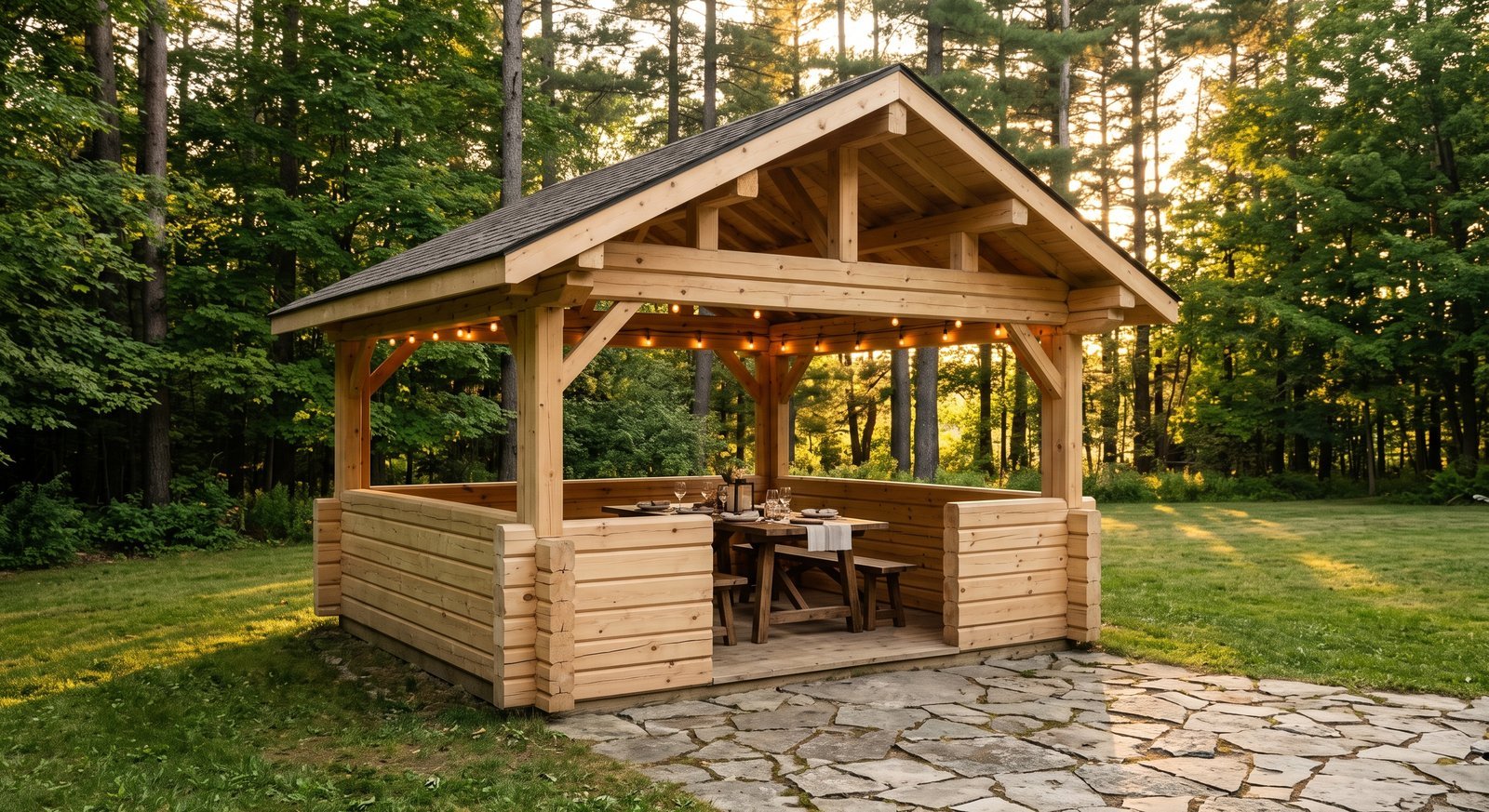
A wooden gazebo is the easiest way to add an outdoor room to a Canadian backyard: a roof over your table, shade at noon, a dry spot when the rain rolls in, and a structure that still looks good under snow. Wooden gazebo kits have made them far easier to build than they used to be. This guide covers the main styles of wood gazebo, how to size one, what Canadian weather demands, and what comes in a typical wooden gazebo kit.
Why choose a wooden gazebo over metal or fabric?
- It stays up all year. Fabric canopies and many soft-top metal gazebos need to come down before the first snowfall. A properly built wood gazebo with a solid roof does not.
- It is quiet and warm. No drumming on a metal roof, no flapping canvas.
- It can be customized. Add screens, curtains, lighting, a ceiling fan or a privacy wall with ordinary screws.
- It ages well. Wood can be re-stained in a new colour; powder-coated aluminium cannot easily be repainted.
Wooden gazebo styles
Open gazebo
Posts and a roof, open on all sides. Light, airy and the least expensive per square foot. Best for dining and as a shade structure.
Semi-enclosed gazebo
Low walls on some or all sides, with the upper part open. This style gives you wind protection at seated height, somewhere to lean a back, and a strong frame. Our gazebo kits are built this way, with interlocking solid-wood wall logs rather than individual posts.
BBQ gazebo or grill hut
A gazebo built around a grill or fire, either open-sided or as a fully enclosed grill cabin with a chimney. Browse our BBQ gazebo and grill cabin kits if cooking is the main purpose.
Pergola
Not technically a gazebo: a pergola has an open slatted roof that gives filtered shade but no rain protection. If that is what you are after, read our guide to pergola kits in Canada.
Square, hexagonal or octagonal?
| Shape | Pros | Cons |
|---|---|---|
| Square/rectangular with gable roof | Easiest to furnish, fits rectangular tables, simplest roof to shingle | More traditional look |
| Hexagonal | Classic gazebo look, good for a round table or central fire | Corners are harder to furnish |
| Octagonal | Most space for a round shape, impressive in a large yard | Most complex roof, highest cost per square foot |
What size wooden gazebo do you need?
| Use | Minimum size |
|---|---|
| Two chairs and a side table | 8×8 ft (64 sq ft) |
| Bistro set or conversation set for four | 10×10 ft (100 sq ft) |
| Dining table for six | 12×12 ft (144 sq ft) |
| Dining for eight, or table plus lounge area | 12×16 ft and up |
| Hot tub shelter | Tub size plus 3 ft on at least two sides; check the tub maker’s ventilation advice |
Two of our popular sizes:
- Rosewood 1.6 in (40 mm) wooden gazebo kit, 96 sq ft (8.9 m²): a cozy space for a small table and chairs.
- Oakshade 1.6 in (40 mm) wooden gazebo kit, 155 sq ft (14.4 m²): a gable-roof gazebo with 7’6″ side walls and a 9’5″ ridge, large enough for a full dining set.
Built for Canadian weather
Snow
Snow loads vary a lot across Canada, and even across Ontario. A wooden gazebo roof should be designed for your local snow load, and you should clear heavy accumulations after big storms, especially wet spring snow. Steeper roofs shed snow more easily.
Wind
Gazebos catch wind like a sail. Anchor the structure to its foundation, never leave it free-standing on pavers.
Moisture
Keep the wood off the ground on a raised base, finish all surfaces with an exterior stain soon after assembly, and add a drip edge to the roof.
Foundation options
- Concrete piers or helical piles under each corner and wall: strong, good on slopes.
- Compacted gravel pad with treated beams: simple and well-drained.
- Existing deck: only if the deck was designed for the extra weight and the gazebo can be fixed through to the framing.
- Concrete patio or slab: ideal if you want a hard floor rather than the gazebo’s own floorboards.
Do you need a permit for a wooden gazebo?
It depends on size and location. In Ontario, small detached structures under 10 m² (108 sq ft) without plumbing are generally exempt from a building permit, and some municipalities apply the 15 m² (161 sq ft) limit to accessory structures used for personal enjoyment. Larger gazebos, or any gazebo attached to the house or a deck attached to the house, usually need a permit. Zoning setbacks and lot coverage rules apply either way. Our article on permit-free building sizes in Ontario explains how the limits work.
What comes in a wooden gazebo kit?
Kits vary, so always read the listing. Our gazebo kits include:
- Precision-cut Nordic spruce wall logs, numbered for assembly.
- Profiled floor boards and roof boards.
- Fasteners and illustrated step-by-step instructions.
Not included: roof covering (shingles, metal or membrane), foundation, exterior stain and delivery, unless stated in your quote. Most owners assemble the shell over a weekend with basic hand tools.
Wooden gazebo kits vs building from scratch
A custom-built wooden gazebo gives you full design freedom, but every angle has to be calculated and cut on site. A kit removes most of the measuring and cutting and arrives with the joinery already done. For most homeowners the kit is faster, cheaper once labour is counted, and far more predictable.
Looking after your wood gazebo
- Apply a quality exterior stain to all surfaces within weeks of assembly.
- Re-coat the sunny and windward sides every three to five years.
- Clear leaves from the roof and gutters each fall.
- Check fasteners and anchors each spring.
Browse our wooden gazebo kits and BBQ gazebos, or contact us for help choosing a size.
FAQ
How long does a wooden gazebo last?
With a dry foundation and regular staining, a solid-wood gazebo can last 25 years or more.
Can a wooden gazebo stay up in winter?
Yes, if it has a solid roof designed for snow. Clear heavy snow after big storms.
How long does it take to build a gazebo kit?
Two people can typically assemble the shell of a mid-size wooden gazebo kit in a weekend, plus time for the foundation and roofing.
Can I put a hot tub in a wooden gazebo?
Yes, with enough clearance for the cover and maintenance, a foundation that can take the weight of the filled tub, and good ventilation. Check the tub maker’s installation guidance.

