
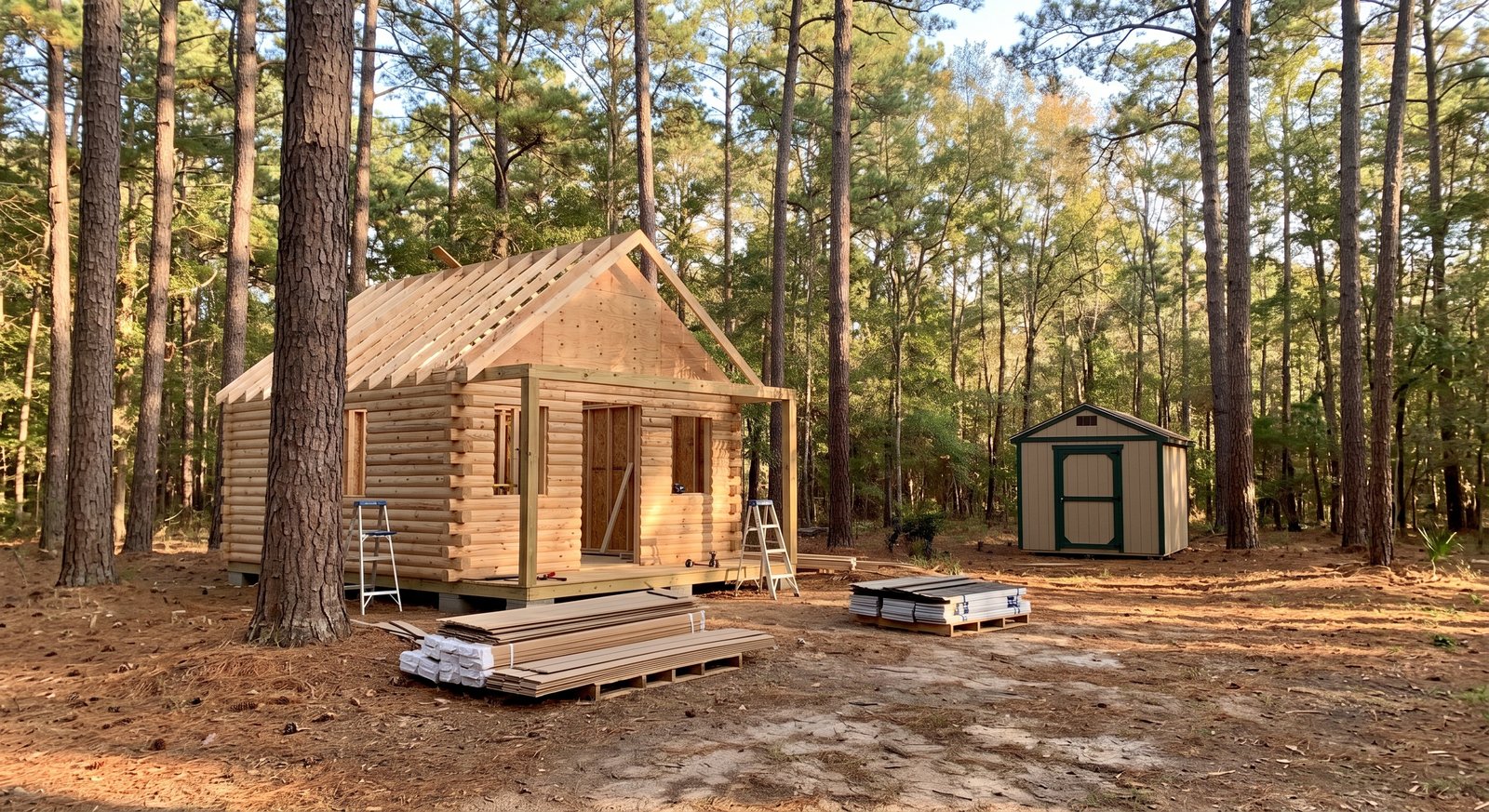
South Carolina does something unusual, and it works in your favour.
In most states, the permit exemption for a small backyard building lives inside the building code — which means a city or county can amend it, tighten it, or interpret it differently. In South Carolina, the exemption is written into state statute. That gives it a stability the code-based exemptions in neighbouring states don’t have.
How the five states compare
South Carolina’s exemption is the most stable of the five, because it sits in statute rather than in code. Here is how the states we ship to across the Southeast compare:
| State | What triggers a building permit | Statutory basis | Notes |
|---|---|---|---|
| Georgia | Over 200 sq ft, or any electrical/plumbing | 2024 IRC with Georgia Amendments (mandatory 1 Jan 2026) | Local amendments allowed; zoning approval still required |
| North Carolina | Any dimension over 12 ft — length, width or height | NC Residential Code | Not an area test. Raleigh requires a permit at any size (zoning permit under 12 ft) |
| South Carolina | Over 200 sq ft | S.C. Code § 40-59-265 — written into state law | Also exempts the owner from contractor licensing. 120 sq ft on commercial property |
| Tennessee | Depends on jurisdiction — see notes | State Fire Marshal residential permits; counties may opt out by two-thirds vote | No state permit for detached structures not used for living purposes, at any size. Local codes override |
| Texas | Inside city limits: varies (Austin 200 sq ft / 15 ft / no plumbing). Unincorporated: generally none | Tex. Loc. Gov’t Code ch. 233 limits county authority to commercial, public and multi-family | Septic, floodplain and deed restrictions apply regardless |
In every one of these states, a permit exemption exempts you from the permit — not from zoning setbacks, lot coverage limits, HOA covenants, easements, flood zone rules, or the code itself.
Last verified September 2026 — codes change, confirm with your local building department.
The statute
South Carolina Code § 40-59-265 lists improvements a residential property owner can make without a building permit. Top of the list:
“one-story detached accessory structures, provided that the floor area does not exceed two hundred square feet”1
The same section also exempts fences up to seven feet, retaining walls up to four feet, decks up to 200 sq ft that are no more than 30 inches above grade, and water tanks up to 5,000 gallons. And it adds something useful: an owner making these improvements “is not required to have a residential builder or residential specialty contractor’s license.”1
In plain terms: under 200 square feet, one story, detached — you can build it yourself, and you don’t need a building permit to do it. That is a genuinely favourable rule for a DIY cabin kit, and it is one of the clearest in the country.
Horry County’s building department applies the same 200 sq ft threshold under the 2021 IRC, with a note that zoning compliance is still required.2 That “zoning compliance is still required” caveat is the one to pay attention to — see below.
The 120 vs 200 confusion
You will sometimes see 120 square feet quoted for South Carolina. Both numbers are real; they come from different codes.
- 200 sq ft — the residential threshold (IRC), which is what applies to a shed or cabin in the backyard of a house.
- 120 sq ft — the commercial threshold (IBC), which applies to accessory structures on commercial property.2
If you are a homeowner, 200 is your number. If you are putting a structure behind a business, it’s 120.
Permit-exempt still means zoning-compliant
The statute exempts you from the permit. It does not exempt you from local zoning, and this is where South Carolina projects actually get stopped.
What to confirm before you order:
- Setbacks. Distance from side and rear property lines. Varies by municipality and district; three to ten feet is typical.
- Rear yard placement. Many jurisdictions restrict accessory structures to behind the rear building line of the house.
- Lot coverage. Total impervious or built area caps, which a shed can push you over on a small lot.
- HOA covenants. In the coastal and Upstate planned communities, architectural review is often stricter than anything the county requires. Written approval first, always.
- Flood zone. Large parts of the Lowcountry are in mapped flood zones with elevation requirements that apply regardless of permit exemption.
Mount Pleasant, Charleston, Greenville and Columbia each publish their own accessory structure standards. One phone call to the zoning office before you order saves a great deal of trouble.
The coast changes the engineering question
South Carolina’s design wind speeds vary dramatically between the coast and the Upstate:
| Region | Design wind speed |
|---|---|
| Immediate coastal (0–5 miles) | 130–150 mph |
| Coastal counties (5–20 miles) | 110–130 mph |
| Midlands | 90–110 mph |
| Upstate | 85–100 mph |
Charleston, Horry, Beaufort and Georgetown counties are the highest-exposure jurisdictions, in the 130–150 mph band and designated windborne debris zones.3 These bands are indicative — the design wind speed for a specific address comes from the ASCE 7 hazard tool or your local building department, and that is the figure to build to.
Here is the honest position on that. A 100 sq ft wooden accessory building is a low-risk-category structure, and the code treats it more leniently than a house. But at 130+ mph, anchoring is not a detail — it is the whole thing. Small buildings in hurricane country fail by lifting off their foundations, not by their walls collapsing.
Straight answer, because it matters more than a sales pitch: these are supplied as standard kits, not as site-engineered buildings. They do not come with stamped structural calculations for a specific address or design wind speed. Inland that is a non-issue. Near the coast it is not something to guess at — have a local engineer specify the foundation anchoring and hold-down detail for your site before you assemble. The kit’s standard fixings are not designed for that exposure, and anchoring is the part you control.
Inland — the Midlands and the Upstate — wind is a non-issue for a kit engineered to Canadian standards. Greenville, Spartanburg, Columbia and Aiken customers can stop worrying about it.
Salt air is the other coastal factor. Within a mile or two of the water, salt accelerates corrosion of fasteners and hardware. Specify stainless or hot-dip galvanised fixings, and re-coat the timber more often than the maintenance schedule suggests.
Termites: the Lowcountry is worst case
South Carolina sits in Zone I — “very heavy” — the highest band of the IRC’s Termite Infestation Probability map, and the coastal plain in particular has some of the heaviest termite pressure in the continental US. Eastern subterranean termites are everywhere in the state, and Formosan subterranean termites — a far more destructive species with colonies several times larger — are established in parts of the Lowcountry.
For a wooden structure this is the most important durability decision you will make. Three rules:
- No soil-to-wood contact. Anywhere. A pier or slab foundation that keeps every piece of structural timber off the ground.
- Six inches of visible foundation between grade and the bottom edge of the wall. This exists so you can see mud tubes forming. Cover it with mulch or soil and you’ve blinded yourself to the problem.
- Ground-contact-rated pressure-treated sill plates, on a capillary break between concrete and wood.
Add an annual walk-around inspection in spring. Fifteen minutes a year is the cheapest insurance available on a $6,000 building.
Our foundation guide covers the options in detail.
Costs
Prices display in US dollars for US visitors, and the wall thickness is what separates the two ranges:
- 28 mm and 40 mm bunkie and shed kits — about $2,200 for a 34 sq ft garden tool shed, $3,250 for a 74 sq ft bunkie, $4,975–5,040 for a 79 sq ft bunkie, and about $7,145 for the 160 sq ft Brookside.
- 70 mm log cabin kits — roughly $11,845 for an 83 sq ft Blueridge, $13,435 for a 103 sq ft Brentwood, and $20,745 for a 161 sq ft Copperbeech.
Every kit is slow-grown Nordic spruce.
Since South Carolina’s 200 sq ft exemption covers essentially our whole current range for homeowners, most South Carolina buyers can build without a building permit. That is a meaningful saving in both money and calendar time compared with, say, North Carolina.
Additional budget items:
- Foundation — piers or slab plus site levelling.
- Delivery — kits ship flat-packed and palletised from our facility in Brampton, Ontario. US delivery is quoted per destination; send us your ZIP code for a price and current lead time.
- Cross-border charges — kits ship from Canada, so duty, brokerage and applicable taxes apply at import. Confirm how these are handled on your order before you buy.
- Anchoring hardware — upgraded specification on the coast.
- Finish — stain or paint on arrival, re-coat periodically. In coastal humidity and UV, treat this as scheduled maintenance.
What people actually build
The 200 sq ft ceiling is generous enough for most non-dwelling uses:
- Home office or studio — the most common request we get. Add power via a licensed electrician; see adding electricity to a backyard cabin.
- She shed or garden room — usually no power at all, which keeps it fully permit-free.
- Storage and workshop — the simplest case.
- Pool house or beach gear store — popular on the coast; watch the flood zone rules.
What you cannot do without a full permit is sleep in it. A permit-exempt accessory structure is not a dwelling, and turning one into a guest suite or short-term rental requires a building permit, habitable-space compliance and local ADU approval.
Frequently asked questions
Does a shed need a permit in South Carolina? Not if it is a one-story detached accessory structure of 200 square feet or less — that exemption is written into state law at S.C. Code § 40-59-265. Local zoning approval is still required, and flood zone rules still apply.
Can I build it myself, or do I need a licensed builder? For the improvements listed in § 40-59-265, including a sub-200 sq ft detached accessory structure, a residential property owner is not required to hold a residential builder or specialty contractor licence.
Is 120 or 200 square feet the right number for South Carolina? 200 sq ft for a residential property. 120 sq ft is the commercial threshold under the IBC.
Will a cabin kit survive a hurricane on the South Carolina coast? Anchoring is the deciding factor. Coastal counties design to 130–150 mph and small buildings fail by uplift, not by wall collapse. These are standard kits without site-specific structural engineering, so near the coast you should have a local engineer specify the anchoring and hold-down detail rather than relying on the kit’s standard fixings.
How long does delivery take to South Carolina? Kits ship flat-packed and palletised from Brampton, Ontario. Price and lead time for US destinations are quoted per address — see our delivery terms or send us your ZIP code.
Building in a neighbouring state?
- Log cabin kits in Georgia — the 2026 code change
- Cabin & shed kits in North Carolina — the 12-foot rule
- Cabin & shed kits in Tennessee — state permits and opt-out counties
- Log cabin kits in Texas — city rules vs unincorporated land
Browse all cabin, bunkie and shed kits, or see what’s included in a cabin kit.
Last verified: September 2026. Statutes and local ordinances change. Always confirm current requirements with your city or county before ordering. This article is general information, not legal advice.
Sources
- South Carolina Code of Laws § 40-59-265, “Exemptions of certain improvements from building permit requirements.” https://law.justia.com/codes/south-carolina/title-40/chapter-59/section-40-59-265/ ↩
- Horry County, SC, “When to get a Building Permit.” https://www.horrycountysc.gov/departments/code-enforcement/permits/building-permit/when-to-get-a-building-permit/ ↩
- South Carolina design wind speed bands under ASCE 7 as adopted in the SC building code; windborne debris designations for Charleston, Horry, Beaufort and Georgetown counties. ↩

